
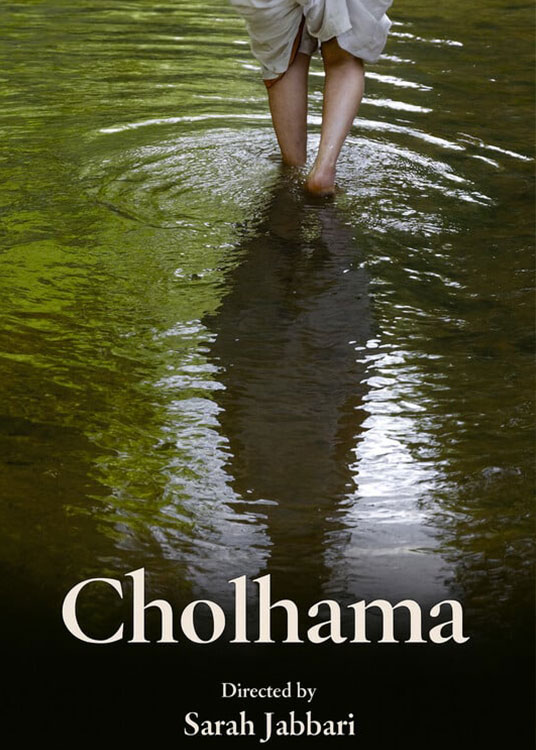
Cholhama is a short anthropological film produced at the Granada Centre for Visual Anthropology, University of Manchester (UK). The film follows Sushil Pandit, a Kashmiri activist living in exile, and explores his embodied memories of displacement. Kashmiri Pandits have lived outside Kashmir since the 1989 exodus caused by rising fundamentalism in the region. Rather than using direct interviews, the film communicates memory and exile through physical gestures, ritual practices, and visual symbolism, focusing on how memories of loss and belonging are carried in the body in the landscape of exile.

Sarah Jabbari graduated with a BFA in Photography from the University of Art in Tehran, Iran. She later undertook specialist courses in photojournalism at the Danish School of Media & Journalism in Denmark, followed by an MA in Art History and a PhD in Fine Arts in India. She went on to publish her first book, Early Perso-Parsi Visual Encounters, on the history of photography in Iran and among the Parsi community in India. Sarah jabbari is an Iranian visual anthropologist. Over the past 15 years, Sarah has worked as a documentary photographer with marginalised communities, including Iranian Baluch, Zoroastrians, Parsis, and Kashmiri Pandits. Her work consistently aims to contribute to social awareness and change. $elective Sympathy, a project focused on Kashmiri Pandit refugees, reflects her commitment to using photography for a greater cause. Her interest in culture and religion led her to study the Avestan language at the Zoroastrian school in Mumbai and to attend the Zoroastrian Summer School at SOAS, University of London. Most recently, with an MA in Visual Anthropology from the Granada Centre at the University of Manchester, Sarah combines film and photography in her visual ethnographic practice and cultural documentation.




 The New York Indian Film Festival (NYIFF) is the oldest, most prestigious film festival screening premieres of feature, documentary and
short films made from, of, and about the Indian subcontinent in the Independent, arthouse, alternate and diaspora genres.
The New York Indian Film Festival (NYIFF) is the oldest, most prestigious film festival screening premieres of feature, documentary and
short films made from, of, and about the Indian subcontinent in the Independent, arthouse, alternate and diaspora genres.